
Premium Phosphosite-Specific 7TM Antibodies
Your Resource for GPCR Research
Select Your Country of Delivery below

CXC Chemokine Receptor 2 Antibodies

Close filters
No results were found for the filter!
NEW
Agonist-induced Threonine347 phosphorylation of the CXC Chemokine Receptor 2
pT347-CXCR2 (phospho-CXC Chemokine Receptor 2...
Threonine347 (T347) is a major phosphorylation site of the CXCR2 receptor. The pT347-CXCR2 antibody detects phosphorylation in response to high- and low-efficacy agonists but not after PKC activation. T347 phosphorylation is a key...
375.00 € *
NEW
 Agonist-induced Serine351/Serine352 phosphorylation of the CXC Chemokine Receptor 2
pS351/pS352-CXCR2 (phospho-CXC Chemokine...
Serine351/Serine352 (S351/S352) is a major phosphorylation site of the CXCR2 receptor. The pS351/pS352-CXCR2 antibody detects phosphorylation in response to high- and low-efficacy agonists but not after PKC activation. S351/S352...
375.00 € *
NEW
Agonist-induced Serine353/Threonine356 phosphorylation of the CXC Chemokine Receptor 2
pS353/pT356-CXCR2 (phospho-CXC Chemokine...
Serine353/Threonine356 (S353/T356) is a major phosphorylation site of the CXCR2 receptor. The pS353/pT356-CXCR2 antibody detects phosphorylation in response to high- and low-efficacy agonists but not after PKC activation. S353/T356...
375.00 € *
NEW
Validation of the CXCR2 Receptor in transfected HEK293 cells
CXCR2 (non-phospho), CXCR2 Chemokine Receptor...
The non-phospho-CXCR2 receptor antibody is directed against the distal end of the carboxyl-terminal tail of human CXCR2. It can be used to detect total CXCR2 receptors in Western blots independent of phosphorylation.
375.00 € *
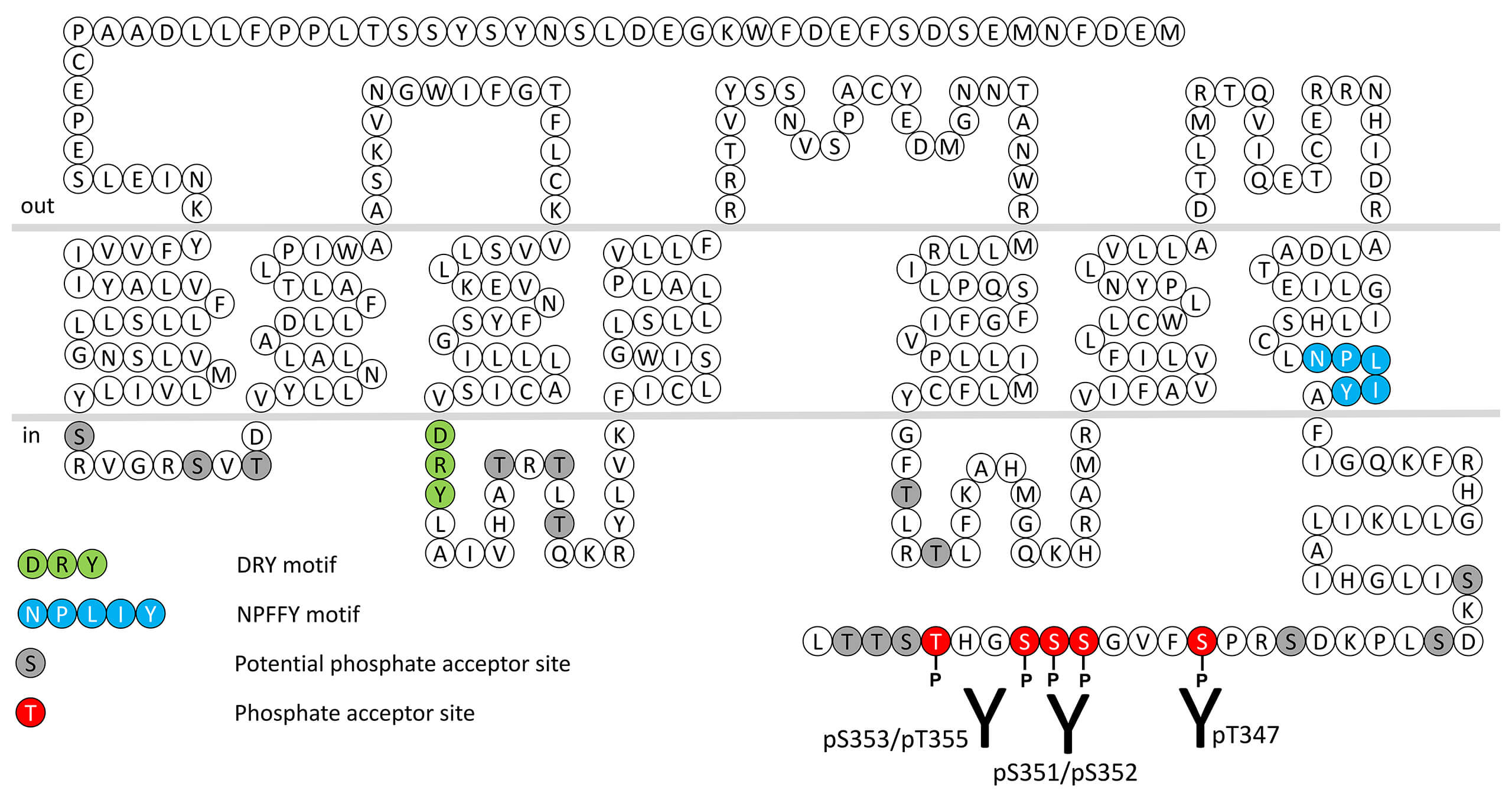
The human CXCR2 is the prototypic neutrophil chemotactic receptor. It can be activated by a variety of ligands including CXCL1, CXCL2, CXCL6 and CXCL8. Several small molecule CXCR2 antagonists including SB 656933 have been discovered. CXCR2-dependent migration requires activation of many proteins that may form a “chemosynapse” with the receptors. Agonists at high concentrations induce phosphorylation of CXCR2, leading to homologous desensitization, receptor internalization, and partial degradation. CXCR2 receptor desensitization, β-arrestin recruitment and internalization are regulated by phosphorylation of carboxyl-terminal threonine347 (pT347-CXCR2), serine351/serine352 (pS351/pS352-CXCR2) and serine353/threonine355 (pS353/pT356-CXCR2). This nomenclature refers to the human CXCR2 but is highly conserved in mice and rats. For more information on CXCR2 pharmacology please refer to the IUPHAR database. For further reading refer to:

Bachelerie F, Ben-Baruch A, Burkhardt AM, Combadiere C, Farber JM, Graham GJ, Horuk R, Sparre-Ulrich AH, Locati M, Luster AD, Mantovani A, Matsushima K, Murphy PM, Nibbs R, Nomiyama H, Power CA, Proudfoot AE, Rosenkilde MM, Rot A, Sozzani S, Thelen M, Yoshie O, Zlotnik A. International Union of Basic and Clinical Pharmacology. LXXXIX. Update on the extended family of chemokine receptors and introducing a new nomenclature for atypical chemokine receptors. Pharmacol Rev. 2013 Nov 11;66(1):1-79. doi: 10.1124/pr.113.007724. Print 2014. Review. Erratum in: Pharmacol Rev. 2014 Apr;66(2):467. PubMed PMID: 24218476; PubMed Central PMCID: PMC3880466.

The human CXCR2 is the prototypic neutrophil chemotactic receptor. It can be activated by a variety of ligands including CXCL1, CXCL2, CXCL6 and CXCL8. Several small molecule CXCR2 antagonists... read more »
Close window
CXC Chemokine Receptor 2 Antibodies

The human CXCR2 is the prototypic neutrophil chemotactic receptor. It can be activated by a variety of ligands including CXCL1, CXCL2, CXCL6 and CXCL8. Several small molecule CXCR2 antagonists including SB 656933 have been discovered. CXCR2-dependent migration requires activation of many proteins that may form a “chemosynapse” with the receptors. Agonists at high concentrations induce phosphorylation of CXCR2, leading to homologous desensitization, receptor internalization, and partial degradation. CXCR2 receptor desensitization, β-arrestin recruitment and internalization are regulated by phosphorylation of carboxyl-terminal threonine347 (pT347-CXCR2), serine351/serine352 (pS351/pS352-CXCR2) and serine353/threonine355 (pS353/pT356-CXCR2). This nomenclature refers to the human CXCR2 but is highly conserved in mice and rats. For more information on CXCR2 pharmacology please refer to the IUPHAR database. For further reading refer to:

Bachelerie F, Ben-Baruch A, Burkhardt AM, Combadiere C, Farber JM, Graham GJ, Horuk R, Sparre-Ulrich AH, Locati M, Luster AD, Mantovani A, Matsushima K, Murphy PM, Nibbs R, Nomiyama H, Power CA, Proudfoot AE, Rosenkilde MM, Rot A, Sozzani S, Thelen M, Yoshie O, Zlotnik A. International Union of Basic and Clinical Pharmacology. LXXXIX. Update on the extended family of chemokine receptors and introducing a new nomenclature for atypical chemokine receptors. Pharmacol Rev. 2013 Nov 11;66(1):1-79. doi: 10.1124/pr.113.007724. Print 2014. Review. Erratum in: Pharmacol Rev. 2014 Apr;66(2):467. PubMed PMID: 24218476; PubMed Central PMCID: PMC3880466.

Recently viewed